
Inspired by the cookbook from my home town entitled "The Heritage of Hospitality,"
for this project, I decided to engage with my Southern roots through the practices associated
share my heritage of Southern hospitality. In order to explore this heritage, I thought it necessary
to consider 'hospitality' both as an inherited system of manners and transmitted set of social gestures
Like Elise's dance documentation, though material artifacts are associated with and indicative of
hospitality, hospitality is ephemeral, embodied, and haptic in nature. It unfolds in relation to material
object; it does not exist inherently in them. However, material objects serve as important signifiers
and conduits for the sharing of hospitable heritage.
First, it is perhaps important to define what hospitality is.
According to the OED
"[a. OF. hospitalité (12-13th c. in Hatz.-Darm.), ad. L. hospitlits, f. hospitlis (see HOSPITAL a.).]
The act or practice of being hospitable; the reception and entertainment of guests, visitors, or strangers,
The act or practice of being hospitable; the reception and entertainment of guests, visitors, or strangers,
with liberality and goodwill."
Using this definition, we might consider hospitality is a set of socially accepted
practices that convey and connote the attitude of 'goodwill'
Why is dinner an engagement with hospitality?
Meals bring people together to commune-- to transmit practices and (re)create and cement social identity.
In this way, meals are a primary stage for the (re)production of hospitality within social groups.
In the South, meals are particularly designed (through set gestures, particular materials, and evocative
affectivity) to foster this emotion. For me personally, meal time has always been centered around
foodways grounded in my heritage: the lovefeast and celebratory meals of the Moravian faith,
the expected components of a Southern meal, the necessity of spending that time with family or
friends who also grew up with similar practices. The food served was inspired by the
'doing-cooking' (cf. De Certeau The Practice of Everyday Life Vol. 2) of my mother, grandmother,
and those in my community. I tried to re-create some of their dishes from memory, tasting as I cooked.
I especially attended to the flavors, ingredients, and taste-combinations that are often used by Southerners.
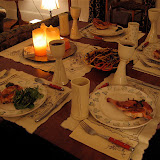
Serving and cooking vessels served as other conduits of haptic, evocative heritage: the meal was served
on plates passed onto me by my mother. I used inherited linens, candles, and flatware, and laid the table
according to the strict rules of etiquette I learned through cotillion and other Southern modes of
transmission of and education in hospitality. Including these inherited implements (and including them
according to inherited systems) was central to my thinking of hospitality as something that is indeed
inherited-- something transmitted across generations through relationships to objects. Timing of this
performance (ie how much cooking/table setting/ etc was completed before their arrival,
how long for appetizers and socializing, how long between courses) was also judged according
to my understanding of the practices of hospitality I have come to associate with my roots in the South.
During our meal, I tried to become conscious of how I was enacting my heritage of hospitality.
How did I attempt tho make hospitality something my guests could perceive?
My performance of hospitality was perhaps conveyed intentionally and unintentionally through body
language and verbal language and material signs. For my guests these prompted a sense of what Southern
hospitality might be. Examples include: my clothes (pearls, apron, cashmere), the table dressing, the manners I displayed
(particularly the subtle cuing of how to eat game hen difficult to do with decorum, etc.
In many ways it felt like playing a part since I was so self-conscious of what heritage I was trying to re-enact:
the role of Southern hostess that I have inherited and learned.
During the meal, my guests and I discussed what we thought hospitality meant and talked about our own
heritages, particularly how we relate to the social eating practices specific to our families and communities.
Much rich conversation was had to augment the indulgent dinner.
On the menu:
-appetizers-
gruyere cheese and water crackers
avocado oil potato chips
-main course-
cornish game hens with proscuitto and basil under the skin accompanied by frozen canales of homemade pesto
parsnip fries dusted with cumin
spinach and arugula salad with hempseed-basalmic dressing, avocado pieces and toasted pinenuts
wine
-dessert-
coconut and chocolate-coconut ice cream with homemade fudge sauce
a thimblefull of scotch
My approach to this project considered hospitality and heritage as haptic.
So, in order to share/represent my heritage of with you it seems necessary to employ haptic means--
not just because it is the intention of this assignment. Some visual representations are included,
but only because that visual is meant to be affective beyond its apparent signification as an image.
Because I also think that heritage is transmitted through small performances and metonymic objects,
places, and practices, I offer nothing which proposes to give you a 'complete' experience. Instead,
I offer fragmentary artifacts of this experience. I have created a sensory museum of hospitality
which contains artifacts of this (re)enactment of my Hospitable Heritage:
A HAPTIC MUSEUM OF THE HERITAGE OF HOSPITALITY
 |
| Hospitality Dinner |
is that exclusiveness inherent in heritage?). Perhaps these artifacts do not convey the larger social tradition
of hospitality. How can this ephermeral/non visible heritage be better represented? I do not have the answer--
however, in an attempt to wrestle with notions of heritage and hospitality and haptic sensation further,
I asked my guests to complete a short assignment.
At the end of the meal, I asked my guests to respond to their sensorial experience
of hospitality by answering one of the following questions:
What is the sound of hospitality (guest respondent Alex Kruckman)
What is the taste of hospitality (guest respondent Nicole Halmi)
What is the smell of hospitality (guest respondent Christina Bodznick)
And I answered the question What is the touch of hospitality
The responses are below:
The sound of hospitality
The taste of hospitality
Hospitality
A taste: salt sprinkling a delicate web over:
cumin, cold coconut, scotch,
warmth: tastes intermingling,
lingering between courses,
but not overpowering.
The smell of hospitality
Hospitality
The top note:
Fowl roasting warm food fog
Vinaigrette and piquant spice
clove, cinnamon, oil of thyme
Herb and honey, heady, heart
The middle note: Le coeur:
Washed, starched, water-distilled,
Linen-dry, floral fresh,
Camphor and fainting cotton violet
The bottom note:
Linger, lemon/agrumen
According with vanilla, yellow, powder
Resin-fixed, anosmia: inability to smell all but beeswax
Hospitality
The top note:
Fowl roasting warm food fog
Vinaigrette and piquant spice
clove, cinnamon, oil of thyme
Herb and honey, heady, heart
The middle note: Le coeur:
Washed, starched, water-distilled,
Linen-dry, floral fresh,
Camphor and fainting cotton violet
The bottom note:
Linger, lemon/agrumen
According with vanilla, yellow, powder
Resin-fixed, anosmia: inability to smell all but beeswax
The touch of hospitality
Some additional considerations, questions, musings, that have emerged:
Is heritage always already haptic and sensational? Is it always already shared?
How is heritage always a performance (ie, a process of showing ourselves to ourselves-- Richard Schechner)
that is at once an affirmation/cementation and (re)creation? In other words--how is heritage always being
remade and thus remaking our social and individual identities/relations to the past?
To suggest that my heritage is hospitality is perhaps problematic--
can heritage be a system of manners? Or, is hospitality, as Prof. Russell pointed out to me, more of a tradition?
(How) can we parse the difference between tradition and heritage?
Does heritage necessitate grounding in material things or physical places?
Do all performative practices have a materiality, however obscure?
Must heritage be related to your bloodlines/social grouping, or could it be learned
(ie, could I teach my guests Southern hospitality, or does that teachability-or not as it may be-
remove hospitality from being an example of heritage)?
The specificity of the meal to specific practices inherited through my family
raises the question of individual heritage (credit Prof. Russell)--
my conception of the Southern heritage of hospitality is specific to my own experience--
is heritage something that can be so intimate, or is a wider experience without such personal individuation that constitutes a group identity?
An individual can have traditions--but when/how do they become heritages?
All of this really is to ask can one speak of a heritage of hospitality?
 Comments for this post